


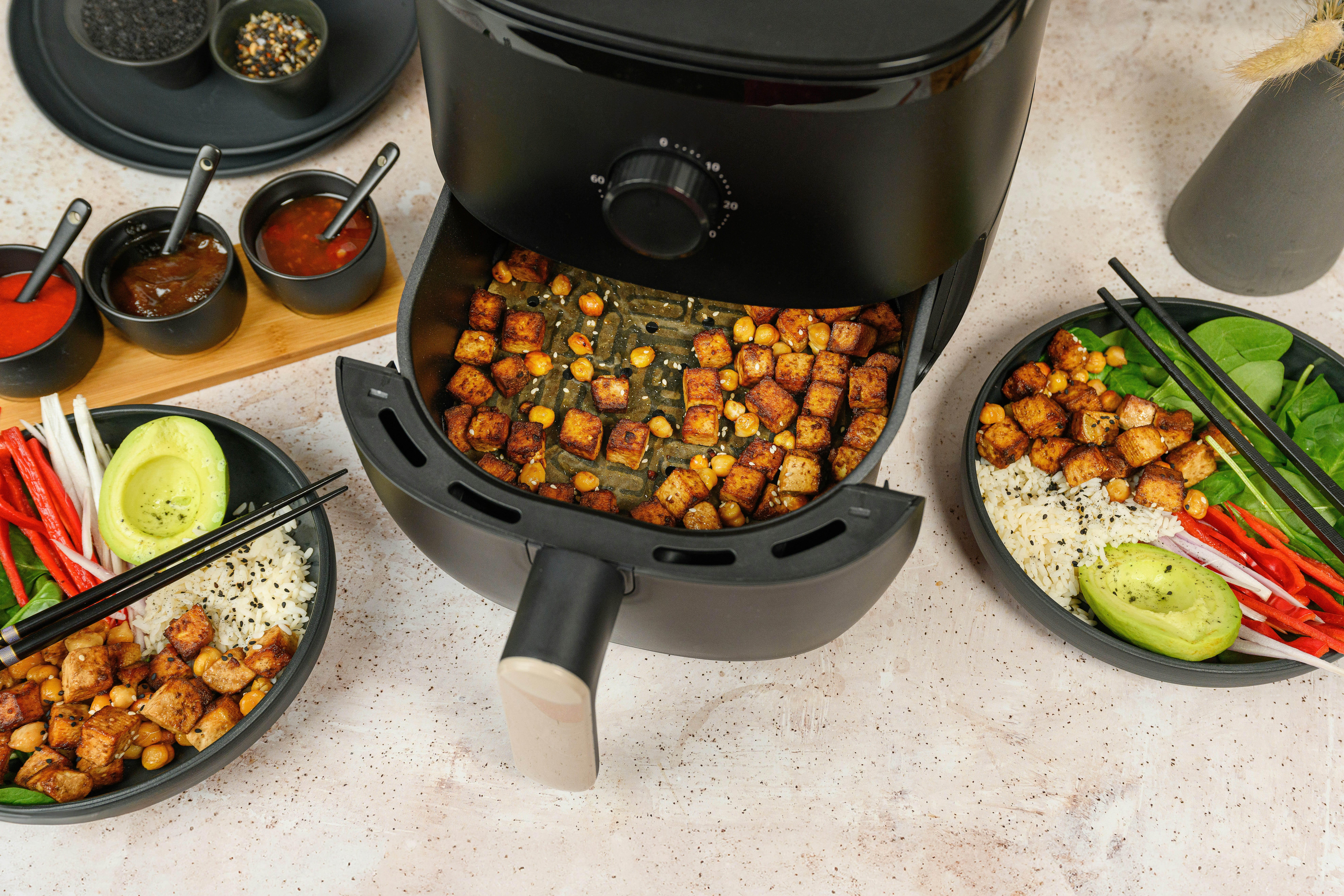
I got an AF (Air-fryer) the other day. I kept hearing about them. But, the name got in the way.
I got the best cheap one. I was pretty sure that the experiment would fail. I didn’t want to feel guilty for having yet another kitchen appliance in the garage.
When it came, it sat on the kitchen shelf for a week daring me to get started. I resisted it still. What if I made a meal and it was terrible?
Then came the Tater Tots. Then the Sweet Potato fries. Then the Orange Chicken.
All were better than you can get in a restaurant. I made a decent meal in about 12 minutes. Without the tool, it would take an hour, the quality would be lower, and the thumb twiddling would be intense.
When you use conventional methods, there are almost always unfilled minutes spent waiting between steps. Tools that help compress completion times while improving quality are quickly adopted.
Eventually.
No one likes being trapped in a cycle of work when a labor saving device is available. As the price drops (it always starts high), the barriers to broad use dissolve. The desire for things that increase freedom (discretionary time)is always an economic trade off.
This is how things, data, and services discover product-market fit.
Actual useful things have a nearly lifelike desire to find the best intersection of price, narrative, and market size. We (as a species) rarely understand the actual meaning of new technologies in our lives before they are in our lives. How do you imagine things you can’t imagine?
And then, what do you do with your newfound time? Can you imagine going back to wasting your time? Abandon the washing machine and start doing laundry on the rocks by the stream?
A big part of how we (as a species) absorb new technology is by having some people in the community who are in charge of exploring new things. In charge, is probably the wrong word. These early adopters try to break the tech, master the tech, and then make it do things the inventors never intended.
Kevin Kelly, cofounder of Wired magazine, is fond of saying, “Never use V1 of anything.” We should let the early adopters get the bruises. It’s sound advice for anyone but the early adopters. It’s our collective good fortune that some people want to, need to, and arrange to go first.
It took the air fryer almost 8 years to reach 10% penetration.
It was almost 15 years to reach today’s 45% market penetration. Invented in 2010, it saw adoption grow as the marketing improved its narrative and the price fell. Introduced at around $300, ours was $70.
Large Language Models have been around for three years. In that time 10% of adults became daily users. Assuming that adoption rates have more to do with people than with the technology, you might predict that it will take LLMs about 6 years to achieve the same 45%. That will work if the price continues to fall and the narrative dramatically improves.
If you listen exclusively to the hype, you’ll hear a level of desperation. It’s caused by the underlying marketing. Big AI company marketing frames the tech as an existential, urgent crisis. ‘If you don’t get ahead of this, you’ll lose your job,” they say.
You can reasonably predict that future AI only vaguely resembles current AI. New technology is always lower quality than the stuff that breaks through. It’s clearly the case now.
While most users are busily trying to automate existing processes, the long term value will be elsewhere. I never considered making fries at home. The AF won me over by helping me make healthy, crispy potatoes. LLMs will have to deliver the equivalent kind of value (helping me do something I never imagined doing) before adoption really kicks.
There is no question. We are headed into an AI future. The actual question is “How long will it take?“
===============
I spent the morning trying to puzzle out some of the HRExaminer’s future. What I noticed is that there seem to be a ton of people saying roughly the same thing. I also noticed that the clearest voices are not parroting the AI company hype.
The real value of AI will be re-imagining the way we do things and learning to do other newer things. The reimagining will happen. It doesn’t seem to have started yet. There doesn’t seem to be the actual urgency that the hype suggests.
================
Photo by Joanna Stołowicz.
People have been afraid of that every time there’s been a technological shift. The (generally wealthy) tech creators seem to have an advantage at first. But, they invariably misunderstand the value and utility of their work. Reimagining is the job of hackers. The originators always think the people who figure it out are doing it wrong.
Love the analogy (and also love our AF), but I think most people will still start with the Tater Tots before they discover the magic. You didn't buy the air fryer to reimagine cooking, you probably expected to make stuff you already knew. The "healthy crispy potatoes at home" revelation came after. Same with AI, I think most organizations will start by automating or augmenting work they already do before stumbling into the reimagined future. The breakthrough comes later, almost by accident. Are you completley screwed if you don't do this now now now? I don't think so, but since that discovery phase takes time, it's worth at least starting to explore.