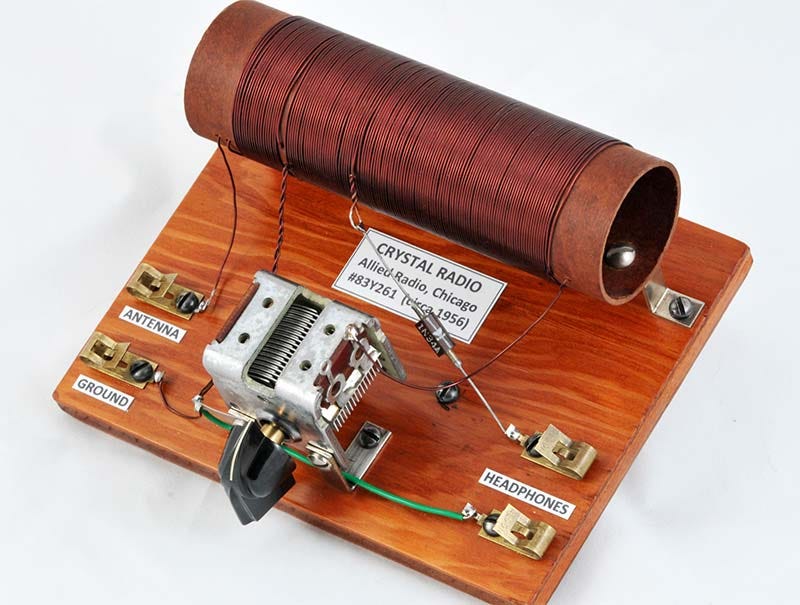
My fascination with electronics started at about 7. That Christmas I got a crystal radio kit. If you’ve never seen one, it runs on nothing but the electricity in the radio waves themselves. No batteries, no plug. Six parts, headphone included.
It was like magic. You held the headphone to your ear and the sound arrived out of nowhere. Night was the best time. Radio waves move differently after dark.
The reason is the ionosphere. It reflects certain frequencies, and the waves bounce between the ground and that layer on their way around the planet. At night, with the sun gone, the layer behaves differently, and some distant stations come in that you’d never catch at noon.
Ten or so stations were licensed at 50,000 watts. From my bed in Virginia I could pull in the Grand Ole Opry out of Nashville and Cousin Brucie on WABC in New York. I stayed up listening.
Tuning was fickle. Weather changed everything. Some nights I got Los Angeles or San Francisco. Some nights I got nothing.
It was like having wings. When the house went quiet I could leave it, reliably, and go anywhere. That’s where my scattered taste in music came from. I knew there was a bigger world, and I knew I’d get to it.
The history runs the same way. Vacuum tubes were expensive, so cheap crystal sets are what actually put radio in front of the public in the early 1920s. People built them at home or bought them. Quaker Oats sold a kit for a dollar and two box tops.
When tube prices fell, louder amplified sets pushed the crystal radio aside. Then the Depression brought it back. Broke people buy what’s simple and cheap, and quality loses to affordability every time the money’s gone.
So the crystal set was the gateway. Simple, cheap, no power required. It put receivers in millions of hands, and those hands became the audience that made commercial broadcasting a business in the first place.
New communication technologies always draw fire, and radio drew plenty. Two of the worries rhyme with what you hear about AI now, though I’d watch the rhyme more than I’d trust it.
The first was that reality would come apart. In the 1930s, critics treated radio as a machine for mass manipulation. The panic story around Orson Welles’ 1938 War of the Worlds broadcast got repackaged as proof that listeners could no longer tell broadcast fiction from fact. The current version says generative tools, deepfakes, and automated disinformation will wear away any shared sense of what’s true, until you can’t trust audio, video, or text.
The second was that somebody’s livelihood was finished. In the early 1930s the newspapers fought radio in the Press-Radio War, trying to choke off its access to the wire services because a fast, free medium looked like the end of print. The current version is the wave of lawsuits from writers, artists, and journalists who expect their work to be ingested, copied, and undercut.
The radio panic didn’t get answered. Television came along and the worry moved over to it by the mid-to-late 1950s. That is the pattern worth noticing. The dread attaches to whatever showed up last, which should tell you something about where it actually comes from.
All new technologies create negative blowback. While it’s not all misplaced, the shakeup of the status quo generates waves of fear as a part of the adoption process. In future articles, I’ll be digging into the evolution of technology and the associated fears.
Fear and panic are natural responses to new technologies. The certainty that relationships will be damaged, industries and jobs destroyed, and young people will be hurt echoes across hundreds of years of tech transitions.
In HR, HRTech, and WorkTech, the debates about the horrors of Ai will probably grow in intensity for a few more years. Then, the next thing will start taking the heat.
Crystal Radio Parts List
Diode (Detector): Traditionally a galena or germanium crystal; it rectifies the alternating current radio signal into direct current audio pulses.
Ground Connection: Hooks to a cold-water pipe or metal rod to complete the antenna circuit safely.
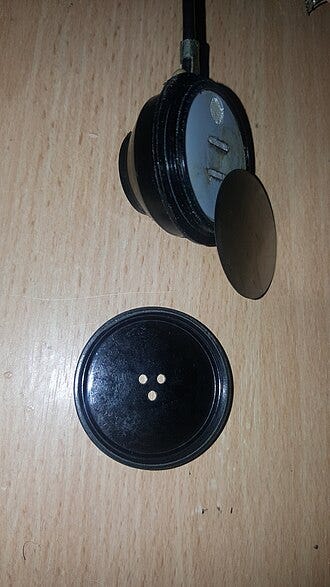
High-Impedance Earphone: Piezoelectric or ceramic earbud which ran on the micro-amounts of electricity generated by the radio waves.
Antenna Wire: 50–100 feet to trap enough physical radio wave energy to power the system.
Tuning Coil (Inductor): Copper magnet wire wound tightly around a form to filter out overlapping frequencies.
Earphone: A single bakelite can holding a magnet, a coil, and a thin steel diaphragm.