



The journey is better if you start out with the end in mind. (It doesn’t mean you’ll get there.) “Why” shouldn’t be a matter of discovery. Leave that to How?, When?, What?, Who?, Where?, How much?
At the most fundamental, HR AI Governance is a defensive effort. The goals are to:
· Protect the organization from risk
· Clarify Authority, Responsibility, and Accountability
· Ensure Compliance with external laws and regulation
· Ensure compliance with internal processes and procedures
· Provide a stable landscape for security
· Provide structure and direction that improve the organization and its culture.
The National Institutes of Standards and Technology (NIST) includes this image in its Cyber Security Framework 2.0.
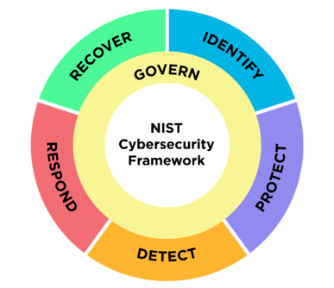
As you can see, NIST believes that great security is built on good governance. It’s kind of obvious…you can’t protect what you don’t know.
AI Governance is the system of rules, roles, responsibilities, and management that controls/ensures that the organization’s intentions, authority, and risk management live within established boundaries. It is how the organization controls autonomous technology while directing it and remaining accountable for its consequences.
It answers seven questions:
1. What are we trying to do with AI? Here, HR can be the example of AI governance rooted in Human Flourishing. Knowing the answer to ‘Why’ makes budgeting and prioritization possible.
2. What AI do we have and how do new projects get started? This begins with an inventory of all the AI projects. Again, budgets and prioritization are the key to effectiveness.
3. Who is responsible for decisions and results? Accountability is the heart of the matter. It is worth noticing that since AI cannot be held liable for outcomes, the organization will have to pinpoint individuals who are responsible for specific AI instances.
4. What is the AI allowed/not allowed to do? Clear definitions of authority, permissions, and boundaries. Humans handle exceptions, errors, boundaries.This part begins with the specification for the AI instance.
5. How do we know if it’s working and when it isn’t? Testing for functionality, error rates, reliability, fairness, safety, compliance, and ongoing monitoring. Testing is evolving. Ai instances need to be tested thousands of times.
6. What happens when it breaks? Detecting failures, improvement requirements, who can intervene, problem correction.
7. How does the organization learn? Converting mistakes and failures into improved policies, systems, practices, and tool refinement.
Two of the questions, Purpose (1) and Organizational Learning (7) stand out.
In the absence of a clearly defined purpose, governance creates massive documentation with no actual impact. Settling in on why we are doing this in the first place creates context. Just controlling the technology is a weak approach. Using the technology to achieve a larger purpose provides the alignment necessary for sensible prioritization and prudent control.
HR is in a remarkable position. Whether or not HR becomes the home to all the organization’s AI governance (unlikely), it is a great point of departure. Picking a target like ‘Human Flourishing’ helps clarify that governance is directed towards effectiveness, not just control. With a clear destination in mind, it is easier to figure out what does and does not support the end game. The opportunity is to demonstrate how to use AI for the good of the organization, not just as a risk control.
As the technology evolves, much of the organization’s learning and development will come from mistakes, big and small. While many organizations are reluctant to collect and monitor mistakes, the fastest way to get the gang on board is to notice what does not work. In those big companies where mistakes derail careers, learning quickly from experience will be a challenge.
Next up. The entirety of HR AI Governance depends on having a clear purpose and knowing all of the AI Instances in the organization.