



I spend my days analyzing the intersection of HR tech, the job market, organizational culture and the sheer hysteria surrounding Artificial Intelligence. Vendors are running around with their hair on fire, pitching Large Language Models (LLMs) as the ultimate cure for workplace friction.
Using these tools feels like strapping on a mental exoskeleton. But the hard part about technological disruption is looking past the immediate magic to see the hidden tax. We are stumbling into a psychological trap.
It’s the hallucination of competence.
We worry constantly about AI hallucinating facts, but we miss the bigger problem: AI makes us hallucinate our own mastery. We are decoupling the painful, messy work of thinking from the final product. Here is how this illusion works.
Seduced by the Surface
Generative AI produces impeccable, authoritative prose. Historically, flawless text meant the author had put in the hard cognitive work to deeply understand the material. Because of this, our brains use a biological shortcut called the “fluency heuristic.” If it reads beautifully, we instinctively assume it’s true.
AI hacks this shortcut.
It hands a worker a perfectly formatted document. Because it looks so polished, the worker’s brain never engages the analytical gears required to check for underlying logic gaps. We mistake aesthetic perfection for conceptual reality.
The Ego and the Prompt
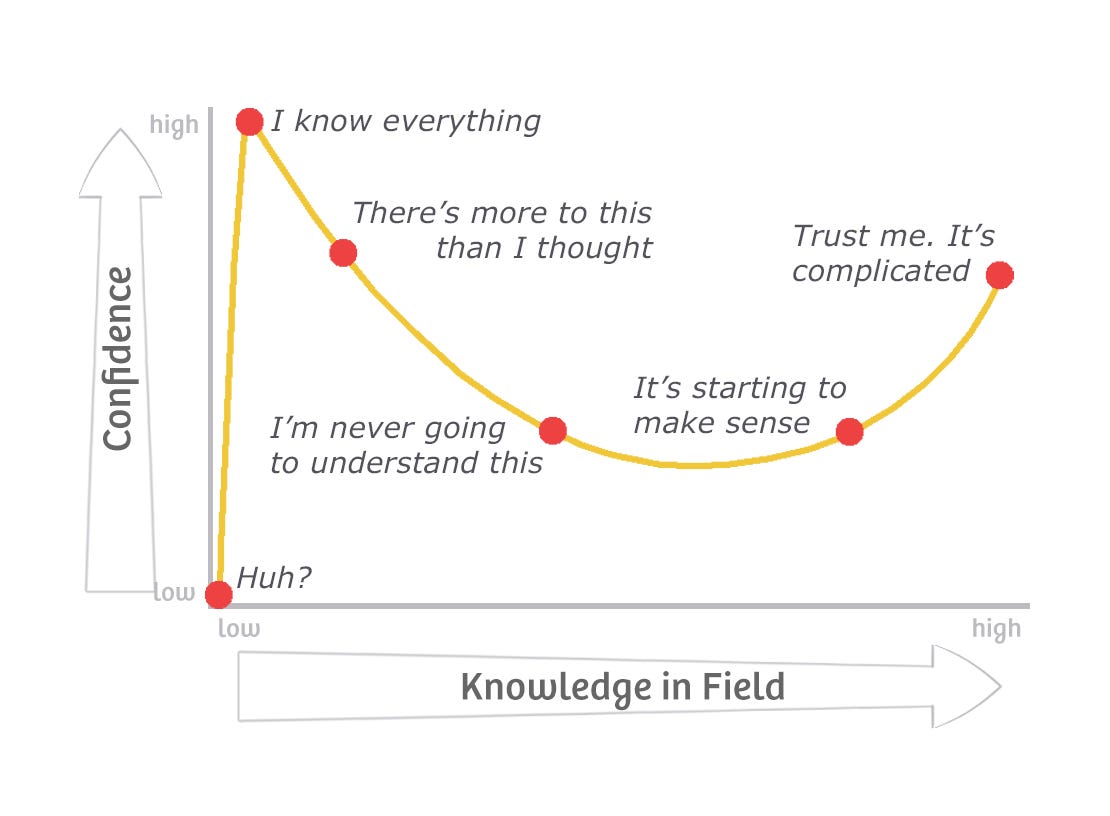
Then there is the blurred line of agency. A manager types a sloppy, ten-word prompt. Three seconds later, the AI spits out a comprehensive strategic analysis. Instead of realizing the machine’s statistical weights did 99% of the heavy lifting, the user unconsciously takes the credit. Over time, workers view the AI’s vast capabilities as a reflection of their own intellect. It’s a massive inflation of self-assessed competence.
Confusing the Map with the Territory
Generative AI doesn’t just fetch links like a search engine; it instantly synthesizes them into a polished conclusion. Workers receive this highly competent document and commit a fundamental category error: they confuse access to synthesized information with internalized understanding.
Because they didn’t sweat over the logic, they haven’t built the mental scaffolding to actually comprehend the material. They possess the final product, but if asked to defend it in a meeting without their laptop, they fall apart. They have the presumption of wisdom with none of the baseline knowledge.
Engineering Out the Muscle Tone
From an HR and Learning & Development perspective, this is where things get truly dangerous. Real human learning requires friction—what cognitive scientists call “desirable difficulties.” Grappling with a complex problem physically changes your brain.
AI short-circuits this loop. It delivers a finished artifact—and a massive dopamine hit of task completion—for zero cognitive effort. It trains the workforce to view mental struggle as an annoyance to be bypassed. We are optimizing away the very friction that makes us smart.
The Illusion of Rigor
When a human writes from scratch, they know exactly where their logic gets fuzzy. The manual process leaves a transparent trail of their limitations. AI hides all of this. The machine doesn’t highlight its own uncertainty; it presents every claim with the exact same authoritative voice. Workers feel like they’ve conducted exhaustive research, when they’ve actually just outsourced their critical thinking to a black box.
The Strategic Advantage of Awareness
It’s easy to look at this intellectual decay and panic. But recognizing the hallucination of competence isn’t a reason to ban AI. It’s actually your greatest strategic advantage.
Once HR leaders and executives understand that frictionless output degrades human expertise, everything changes. Understanding this trap is the blueprint for using the technology correctly. It allows us to intentionally design workflows that reintroduce friction where it actually matters.
When you know the illusion exists, you stop training employees to be passive prompt-pushers and start developing them into rigorous editors, critical interrogators, and systems thinkers. You use the AI to gather and organize raw material, but you force the human to do the heavy lifting of logical vetting.
The organizations that win won’t be the ones that automate away all their cognitive friction. They will be the ones who understand this psychological trap and use that awareness to build a workforce where technology scales output, but the human brain retains its muscle tone.
Photo by Raimond Klavins on Unsplash
Dunning-Kruger Model from AgileCoffee