


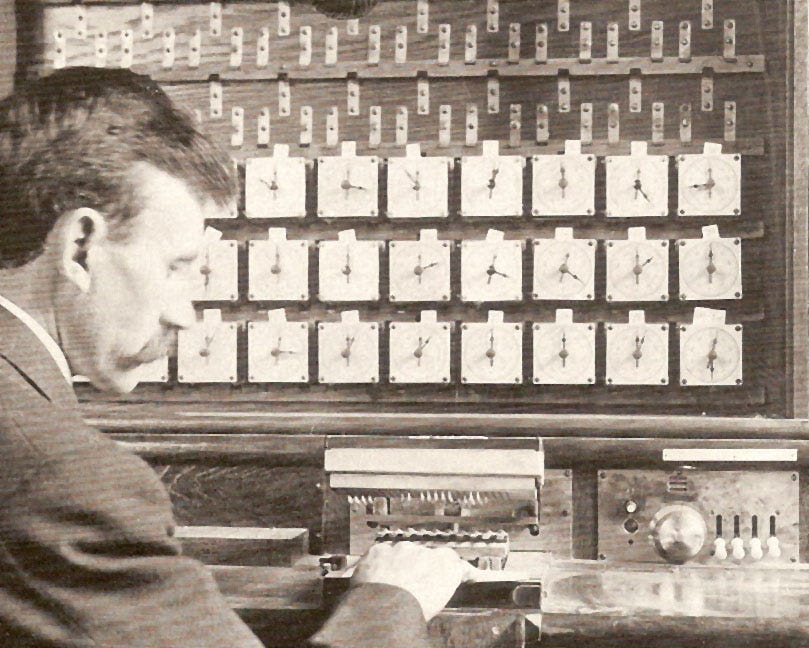
Everybody starts the story of HR technology in 1951. That was the year an electronic computer first ran a routine business job. It is a fine place to mark the electronic inflection.
It is the wrong place to begin.
Punched-card machines were running payroll, accounting, and personnel records for half a century before anyone switched on a stored-program computer. The longer lineage is worth understanding. It shows HR being shaped by data-processing capability before the computer existed.
Technology drives the evolution of HR. It was already doing the driving when the machines were still mechanical.
The punched-card era (1890s to 1940s)
The first large-scale human inventory in this country was the census. Herman Hollerith built punched-card tabulating machines to process the 1890 count. The machines replaced manual review with mechanized counting and sorting.
Hollerith founded the Tabulating Machine Company in 1896. It merged into the Computing-Tabulating-Recording Company in 1911. CTR was renamed International Business Machines in 1924.
IBM went on to define corporate computing. The work to count people in the census made HR’s adoption possible.
For the first half of the twentieth century, large employers ran payroll, accounting, and personnel accounting on punched-card equipment. Railroads, insurers, and government agencies did the same. Keypunches, sorters, tabulators.
None of it was a computer in the modern sense. All of it was machine-readable employee data at scale.
That is the real ancestor of the HR database.
When electronic computers finally arrived, their first job was taking over the work the punched-card systems were already doing.
The electronic inflection (1951)
The first business application on an electronic computer was not payroll. It was not American.
In November 1951, J. Lyons and Company ran a job called Bakery Valuations. Lyons was a British tea-shop and catering business.
The machine was the Lyons Electronic Office. Lyons built it themselves.
People generally regard this as the world’s first routine business computer application. Payroll for Lyons’ own staff followed around 1953 or 1954. By 1956, LEO was running payroll as a bureau service for Ford UK and others.
A tea company built the first business computer.
The conventional history loses that detail. It is worth keeping, because it tells you something true about how this industry actually moves. The pressure to pay people and value inventory was concrete and recurring.
HR technology is almost always a use case for technology invented for other purposes.
American payroll went electronic in the mid-1950s. The UNIVAC I and the IBM 650 were reaching large employers.
General Electric ran payroll on a UNIVAC I at its Appliance Park facility in 1954. That run is usually cited as the first American business-payroll application.
There are two different firsts here. Most histories blur them.
Lyons was the first company to run its own payroll on a computer. Automatic Data Processing was the first payroll services company.
ADP was founded in 1949 as Automatic Payrolls, Inc. It processed payroll on behalf of clients. It eventually dominated the outsourced business.
From master files to the system of record (1958 to 1990)
Once payroll data existed in machine-readable form, personnel data followed. By virtue of being first, Payroll became the organizing principle for all HRTech. You can think of most HRTech/WorkTech as an extension of the payroll record.
Computerized employee master files showed up in the late 1950s and early 1960s. Integrated payroll-and-personnel systems came together through the late 1960s and early 1970s. Databases, disk storage, and management information systems made that possible.
Again, HR’s evolution follows the emergence of technology.
The first commercial HR software vendors arrived in the early 1970s. The term HRIS was in common industry usage by decade’s end.
The single system of record for the whole employee population is largely a product of the 1980s. That is what most people picture when they hear HR technology. PeopleSoft, founded in 1987, together with Lawson and SAP, brought client-server architecture and relational databases to the function.
For roughly its first four decades, HR technology answered three questions and not many more.
Who works here. What do we pay them. What benefits do they get.
It was record-keeping and transaction processing. It was good at it.
The internet, the cloud, and the shift to recruiting (1990s to 2010s)
From the 1990s the center of gravity moved from records to workflow and recruiting. Enterprise HCM suites, networked PCs, and graphical interfaces standardized HR across the organization.
Then the internet moved recruiting online through job boards and applicant tracking systems. The web let employees and managers serve themselves.
Cloud and SaaS architecture turned HR software into a subscription. Workday marked that shift in 2005. Cheap storage and machine learning made people analytics a discipline of its own.
The job changed from recording what happened to predicting what would happen next.
From records to prediction to judgment support (2022 to present)
The current inflection is generative AI. The cleanest way to frame it is as the fourth move in a long progression.
HR technology started as a record-keeper that told you what happened. It became a reporter that told you what was happening. It became an analyst that told you why.
Then it became a forecaster that told you what would happen next.
Now it is trying to become a participant in the decision itself. It wants to tell you what to do.
The difference between prediction and judgment is the whole game.
A prediction states a probability. This employee has a meaningful chance of leaving in the next six months. That is where it stops.
A judgment-support system goes further. It frames the decision. Here are the interventions worth considering, with the evidence behind each one, the cost, the risk, and the likely result.
A human still owns the call at the end.
Large language models are what make that possible. They can reason across different kinds of evidence. They can say their reasoning out loud in plain language.
The machine-learning models that came before could not do that.
The emerging applications run across recruiting, internal mobility, workforce planning, compensation, and employee relations.
A word of caution about the vendor names attached to this category. Treat them as directional rather than settled.
The space is moving fast. The line between a shipping product and a roadmap slide is still blurry.
Some of what’s getting sold is a prediction wearing a better interface. Some of what’s sold as an AI agent is employee self-service with a fresh coat of paint.
The buyer’s job is to tell the difference.
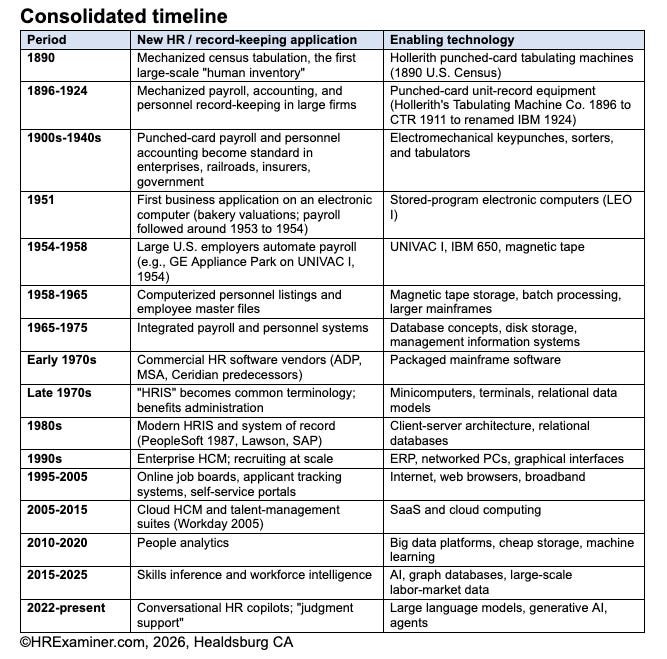
Here’s another way of thinking about it.
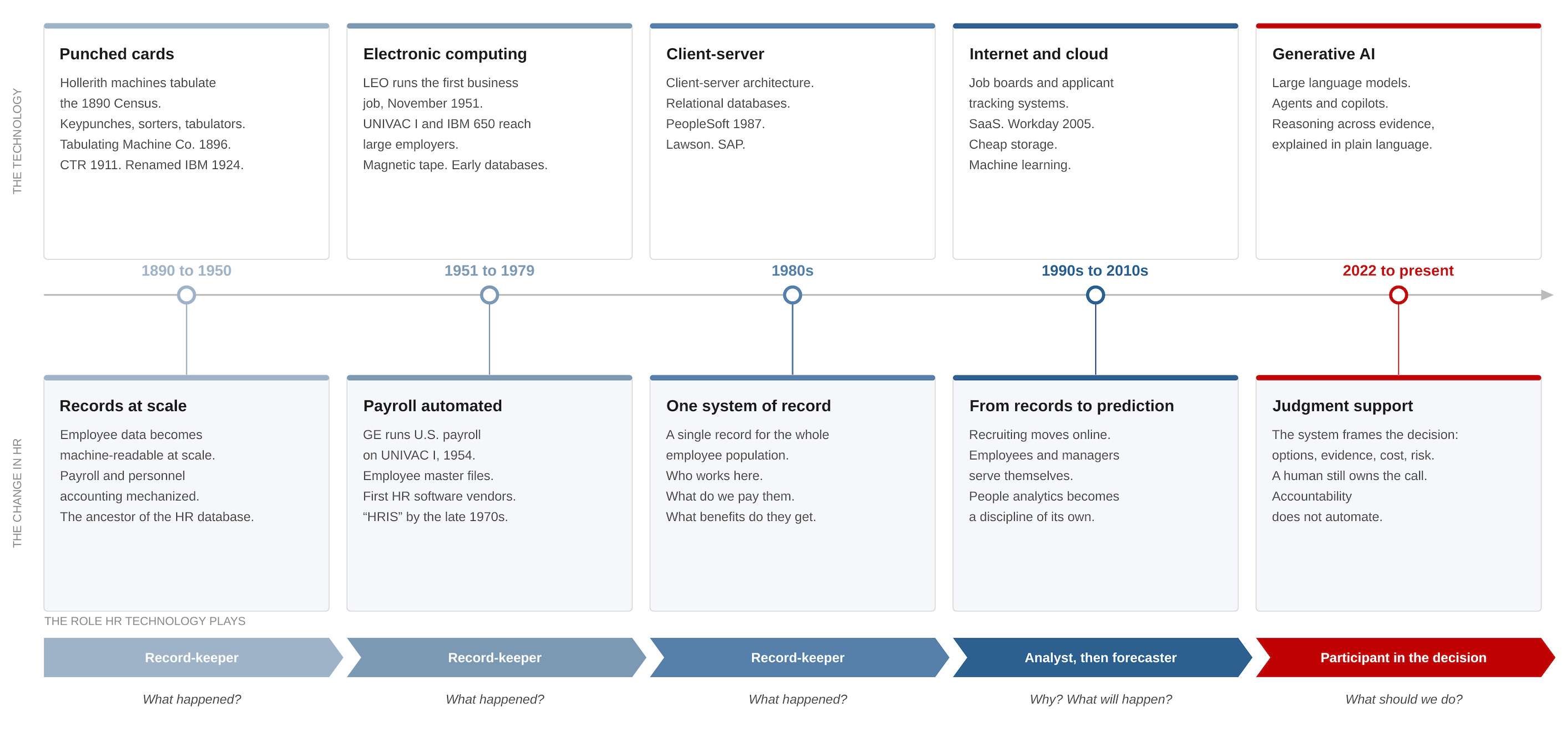
Read the whole history this way and the pattern is hard to miss. Each new capability arrived and opened a bottleneck or an opportunity. HR reorganized itself to handle what the machine made possible.
That engine has not stopped.
The interesting question now is not whether the software gets smarter. It will. The question is what stays human once the machine can assemble the evidence, weigh the alternatives, and draft the recommendation.
Accountability does not automate.
Somebody still has to own the decision. Somebody has to own being wrong about it. The history suggests that is the part of human resources that goes last, if it goes at all.